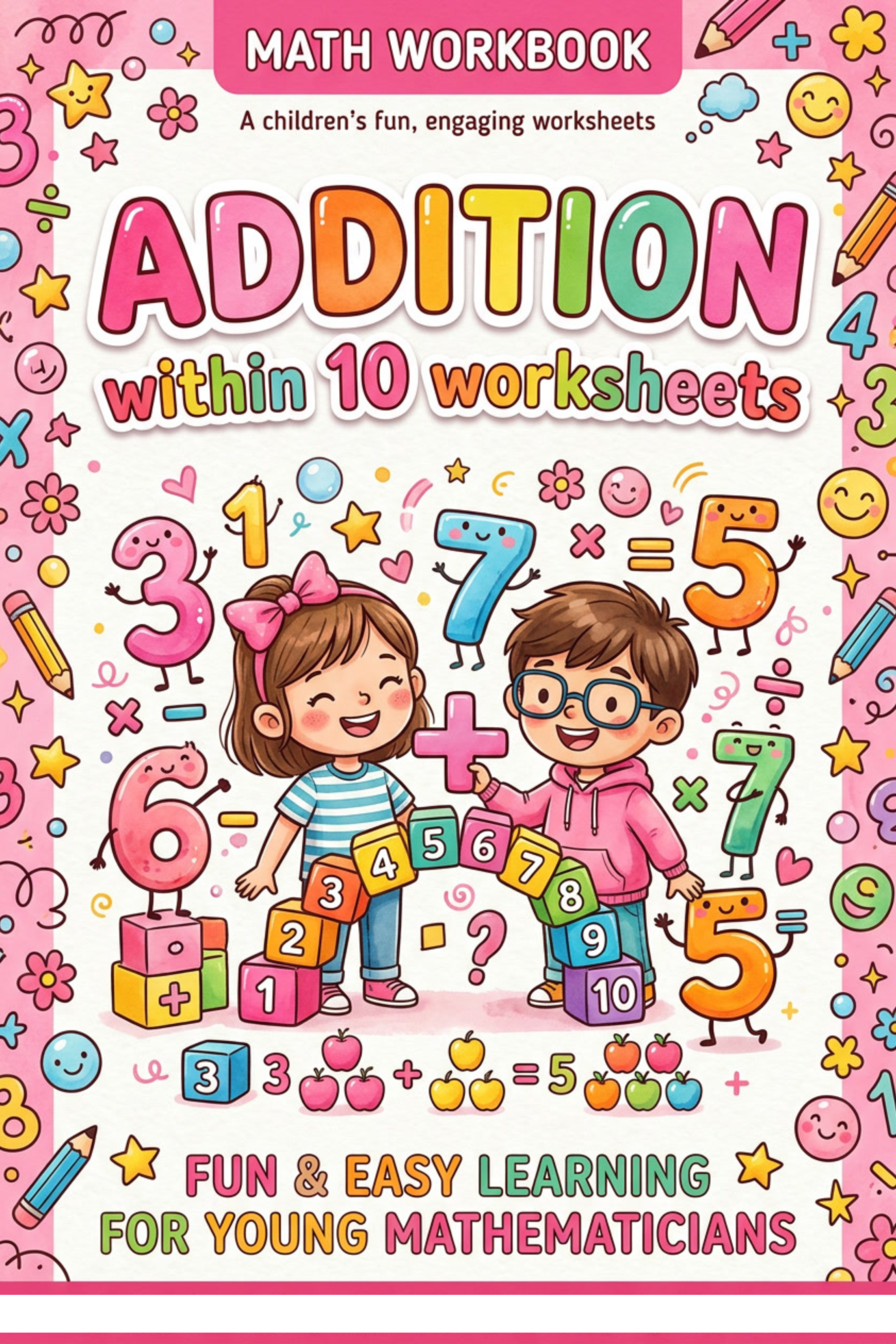
Free addition within 10 worksheets
Helping your child learn addition doesn’t have to feel overwhelming.
In first grade, children begin building the foundation for all future math skills. Before they can confidently tackle larger numbers, word problems, and mental math, they need a solid understanding of simple addition facts.
That’s why I created this addition within 10 worksheets.
These printable worksheets are designed to help children practice addition in different ways so learning feels engaging rather than repetitive. Each page focuses on a specific skill while keeping the activities simple, clear, and easy for young learners to complete.
Whether you’re a parent looking for extra practice at home or a teacher searching for a quick math activity, these worksheets can help children gain confidence with addition facts within 10.
Addition within 10 is introduced in Week 3 of the 10-Minute Grade 1 Math Program after children have practiced number bonds and number sense skills.
Pin it for later!
Free addition within 10 worksheets
1. Simple addition facts
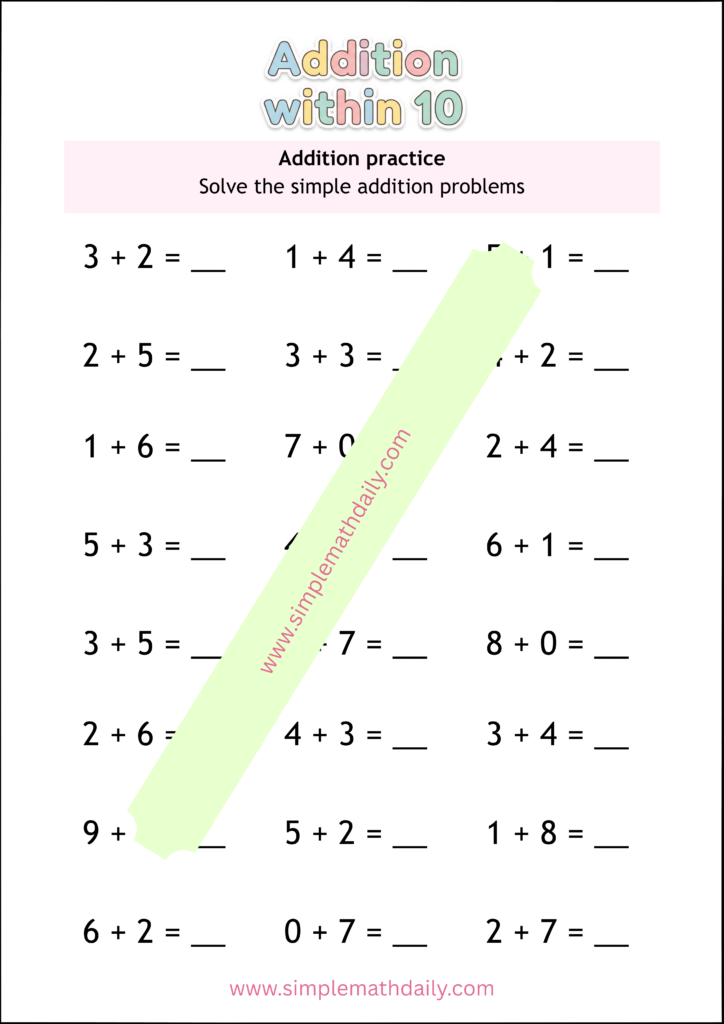
This page focuses on straightforward addition practice.
Children solve basic addition equations such as:
- 2 + 3
- 4 + 1
- 5 + 4
The goal is to build familiarity with addition facts and improve fluency through repetition.
How it helps:
When children repeatedly practice simple addition facts, they begin recognizing answers automatically instead of counting every time. This improves speed, confidence, and overall number sense.
How to use it:
- Use as a daily 5-minute warm-up.
- Complete one section at a time.
- Encourage children to say the addition sentence aloud before solving.
- Repeat the worksheet on different days to reinforce learning.
Download A4 worksheet
Download US worksheet
2. Add and match (picture + equation)
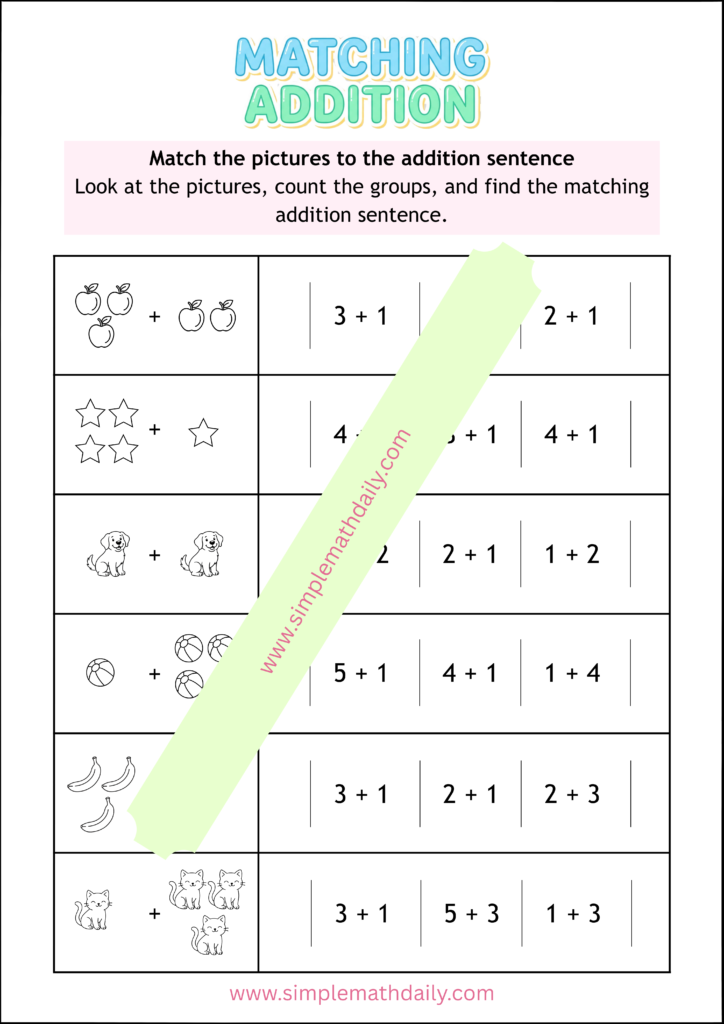
This worksheet combines visual counting with addition equations.
Children count groups of objects and match them to the correct addition sentence.
For example:
🍎🍎 + 🍎 = ?
Children identify the matching equation before solving.
How it helps:
Many children understand math better when they can see quantities visually.
This activity helps connect:
- Concrete objects
- Counting skills
- Addition equations
It bridges the gap between counting items and understanding abstract number sentences.
How to use it:
- Ask your child to count each group out loud.
- Point to each object while counting.
- Have them explain why they chose a particular equation.
- Encourage them to check their answer by recounting.
Download A4 worksheet
Download US worksheet
Looking for a simple way to make math practice part of your daily routine? Download the FREE first week of my math foundations program and see how easy structured learning can be. This beginner-friendly sample includes engaging worksheets and quick exercises designed to help children build confidence without feeling overwhelmed.
It’s the perfect way to try the program and discover how just a few minutes of focused practice each day can support your child’s math journey.
3. Addition number line jumps
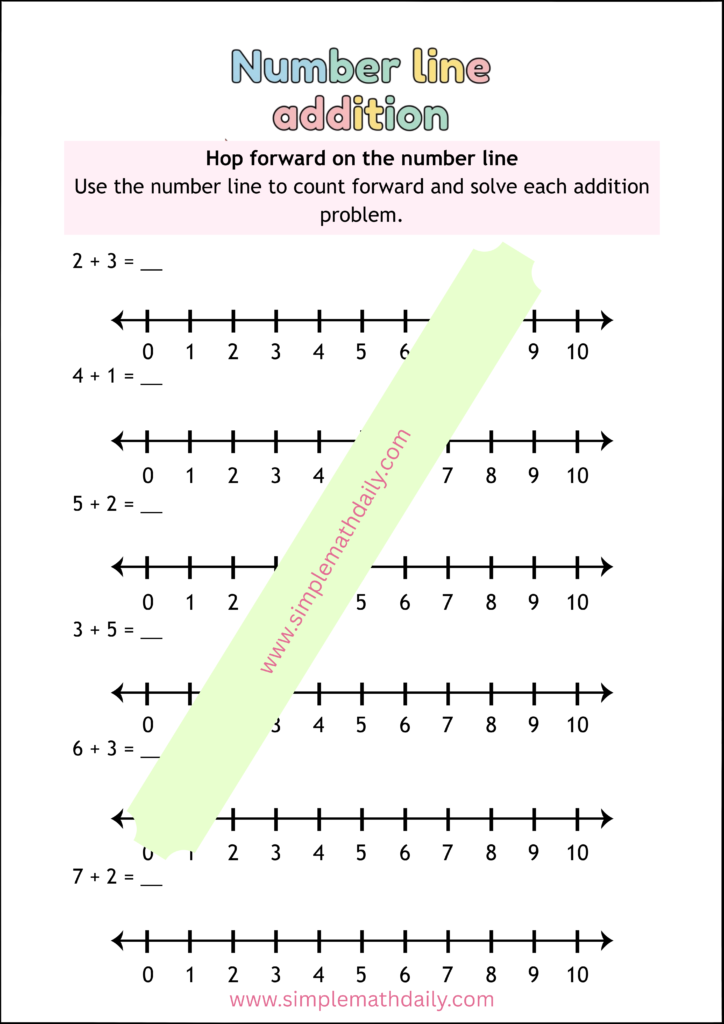
This worksheet introduces addition using a number line.
Children start at one number and make forward jumps to find the answer.
For example:
Start at 2 → Jump 4 spaces → Land on 6
How it helps:
Number lines help children understand what addition actually means.
Instead of memorizing facts, they can see addition as moving forward along a sequence of numbers.
This visual approach strengthens number sense and supports future mental math skills.
P.S.= for the last 2 exercises (5. and 6.), your child should draw the arrow. You can check if they have understood how it works!
How to use it:
- Trace the jumps with a finger.
- Count each jump aloud.
- Encourage your child to notice patterns.
- Gradually challenge them to solve without physically counting every jump.
Download A4 worksheet
Download US worksheet
Tips for parents
When practicing addition, short and consistent sessions often work better than long lessons.
Try these simple strategies:
- Practice for 5–10 minutes a day.
- Praise effort and persistence.
- Allow mistakes as part of learning.
- Use real-life examples such as counting snacks, toys, or steps.
- Mix worksheet types to keep practice interesting.
Remember, confidence grows through repetition. A child who practices addition a little each day will usually make more progress than a child who completes a large amount of work once a week.
Final thoughts
Learning addition within 10 is one of the most important early math milestones.
These worksheets help children practice addition in multiple ways—from solving equations and matching pictures to using number lines and completing fun color-by-sum activities.
By combining visual learning, hands-on thinking, and repeated practice, children can build a stronger understanding of numbers while developing confidence in their math abilities.
Download the worksheets, grab a pencil, and enjoy a few minutes of meaningful math practice together.