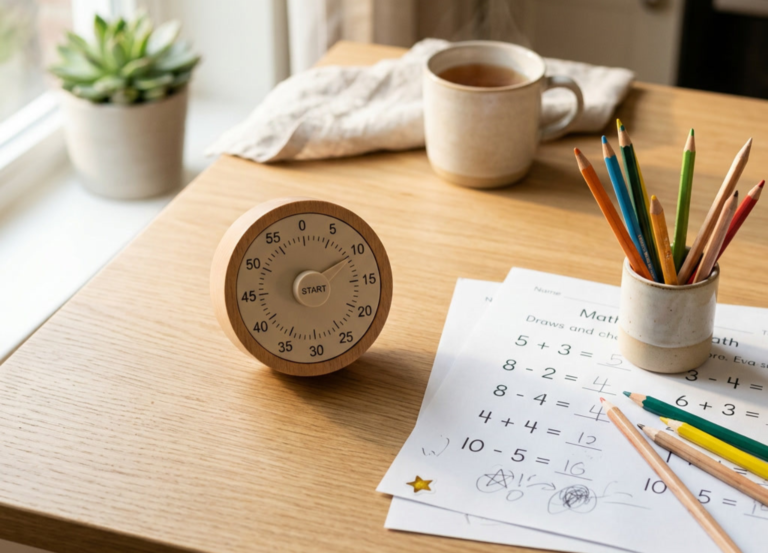
How to teach addition to a 7-year-old without frustration
Let me guess how this usually starts.
It’s homework time. Or maybe it’s just a few practice problems you pulled together because the teacher mentioned your child could use a little extra work. You sit down at the kitchen table. You’ve got a pencil, a eraser, maybe some crackers or coins if you remembered. You’re feeling okay. Hopeful, even. This is going to be quick, you think. Just a few minutes and then they can go play.
And then something shifts.
Your child stares at the page like it’s written in a language nobody ever taught them. They start messing with the pencil. Scratching at a spot on the table. They guess seven when the problem is two plus two. They guess three when it’s five plus one.
You try to keep your voice calm, but you can feel the temperature in the room changing. The air gets heavier.
Maybe they say it out loud: “I’m bad at math.”
Maybe they don’t say anything. They just put their head down. Or push the paper away. Or stare at the wall.
And if you’re honest, that moment hits you right in the chest. Not because you care about getting the right answer, but because you see your child hurting. You see them starting to believe something about themselves that you know isn’t true. And you don’t know how to stop it.
Then come the questions you ask yourself late at night or in the quiet after they’ve gone to bed.
Why is this so hard for them? Other kids seem to get it.
Am I explaining it wrong?
Should they already know this?
What if they fall behind and never catch up?
Those thoughts spiral fast, especially when all you really want is to see your child feel confident and capable again.
So let me say this first, before we talk about numbers or strategies or anything else.
You are not doing anything wrong. And your child is not failing.
I know it feels that way sometimes. I know it’s hard to watch. But what you’re seeing is actually incredibly common. More common than most parents realize, because nobody really talks about it.
Here’s what’s actually going on inside your child’s head.
Pin it for later!

Why addition feels so much harder than it should
We adults, look at something like 7 plus 4 and think, come on, that’s just counting up a little bit. But for a seven-year-old brain, addition isn’t one thing. It’s about five different things all happening at the same time.
1. Your child has to understand what numbers even represent. That sounds basic, but a lot of kids at this age are still building that mental picture of what “seven” actually means. Is it a pile of blocks? A spot on a number line? A word they’ve memorized?
2. They have to hold both numbers in their working memory long enough to do something with them. That’s harder than it sounds, especially if they’re tired or hungry or already feeling a little frustrated.
3. They need to recognize patterns. They have to see that 4 plus 2 is related to 5 plus 2 in some way, that the answer is just one more.
4. They need to recall facts they’ve practiced before, but facts they haven’t truly memorized yet. That puts a heavy load on a young brain.
5. They have to stay calm enough to think clearly. Because the moment frustration or shame or fear shows up, the thinking part of their brain basically goes offline. They’re not being difficult on purpose. They’re just flooded.
So no, it’s not that your child “isn’t good at math.” It’s that their brain is being asked to juggle too many things at once, and one of those balls keeps dropping.
The good news is, you don’t need to fix all of that at once. You just need to slow things down enough that the juggling act becomes manageable.
A truth that took me a while to learn
Here’s something I wish someone had told me earlier.
Most children do not learn math better when you add more pressure or more worksheets or more complicated strategies. They learn better when things feel clearer. Calmer. More predictable.
Think about how kids learn anything else. Riding a bike. Tying their shoes. Learning to read. It’s never a straight line. They do it over and over. They make mistakes, get frustrated and they walk away and come back. Magically one day, it just clicks.
Addition works exactly the same way.
Progress almost never looks dramatic. It looks like a tiny moment where your child gets one problem right without guessing. Then another one a day later. Then a whole row. Then they forget everything for two days and you feel like you’re back at square one. After that they suddenly remember again.
Those tiny moments stack up. They matter more than you think. But you have to be patient enough to let them happen.
How to teach addition to a 7 year old
Where most parents start (and why it backfires)
Most parents, with the very best intentions, jump into problems that are just too hard for where their child actually is right now.
They open a workbook. They look at the page and point to problems like 8 plus 5, 9 plus 6, 12 plus 4. And their child freezes.
Not because they can’t ever learn those problems. But because the foundation underneath those numbers is still shaky. It’s like trying to build a second story before the first floor is solid. You can’t. It just falls apart.
So here’s what I’ve learned, and I know this sounds almost too simple, but it works.
Start smaller than you think you need to. Way smaller.
Forget what the teacher says they “should” know by now. Forget what the neighbor’s kid can do. Just meet your child where they actually are today.
If that means doing problems like 2 plus 1 and 3 plus 2 for a whole week, then that’s what you do. Not because you’re giving up. Because you’re building confidence from the ground up.
When your child solves a problem and gets it right, even an easy one, something changes in their brain. They feel successful. And a successful child approaches the next problem completely differently than a discouraged child does.
Confidence tells their brain: I can figure this out. That belief is worth more than a hundred worksheets.
The power of boring, repetitive practice
This is the part that makes parents nervous because it feels too simple. You might look at it and think, this can’t possibly be enough.
But repetition is where real learning lives.
A child’s brain needs to see the same pattern over and over before that pattern starts to feel natural. So don’t jump around. Don’t mix addition with subtraction yet. Don’t throw in word problems. Just stay with one thing.
For example, stay with adding two.
- 3 plus 2
- 4 plus 2
- 5 plus 2
- 6 plus 2
- 7 plus 2
Watch what happens after a few days of this. Your child might not even realize they’re learning, but they’ll start noticing things. Hey, the second number never changes. Oh, the answer just goes up by one every time.
That noticing is number sense. And number sense is what makes all future math easier. Without it, math feels like random guessing. With it, math actually starts to make sense. And when things make sense, frustration starts to fade.
Keep it short
Here’s something that happens again and again.
A child gets a few problems right. The adult helping them gets excited. Let’s do five more! And by the sixth or seventh problem, the child is slumped over the table, staring into space. The adult is holding back the urge to say, come on, you just did this.
The truth is, after about ten or twelve minutes, most seven-year-olds are done. Not because they’re being difficult. Not because they’re lazy. Their brains are genuinely tired. Focus drops. Frustration rises. And what started as a good practice session turns into a battle.
So here’s what works instead. Ten minutes. That’s it. Set a timer if you need to.
Ten minutes feels manageable to a child. It doesn’t overwhelm them. And because it’s short, you’re more likely to actually do it every day. That daily consistency is where the real progress happens.
A little bit every day teaches a child’s brain: This is normal. This is safe. I know what to expect. And over time, math stops feeling like something to fear.
I’ve written a 10-minute math routine for kids that actually works, so don’t forget to check that up.
How to know when to move on
This is the part that trips up a lot of parents.
Your child gets a few problems right. You feel proud. You think, okay, they’ve got it, let’s move to the next thing. And then the next day, they can’t do it anymore. What happened?
Nothing happened except normal learning. Kids forget things. They understand something one day and lose it the next. That’s not failure. That’s how brains work.
So here’s a better rule. Stay with a set of problems until your child can do them easily, without guessing, for several days in a row. Then take one small step forward. Not a big leap. A tiny step.
If they were doing 3 plus 2, try 4 plus 2. Stay there until it’s easy.
Then 5 plus 2. One step at a time.
If they stumble, go back one step. Let them feel successful again. Then try the harder one another day.
This is not moving backward. This is building something that will actually hold.
What this looks like at your kitchen table
Let me give you a real example, because sometimes that helps more than advice.
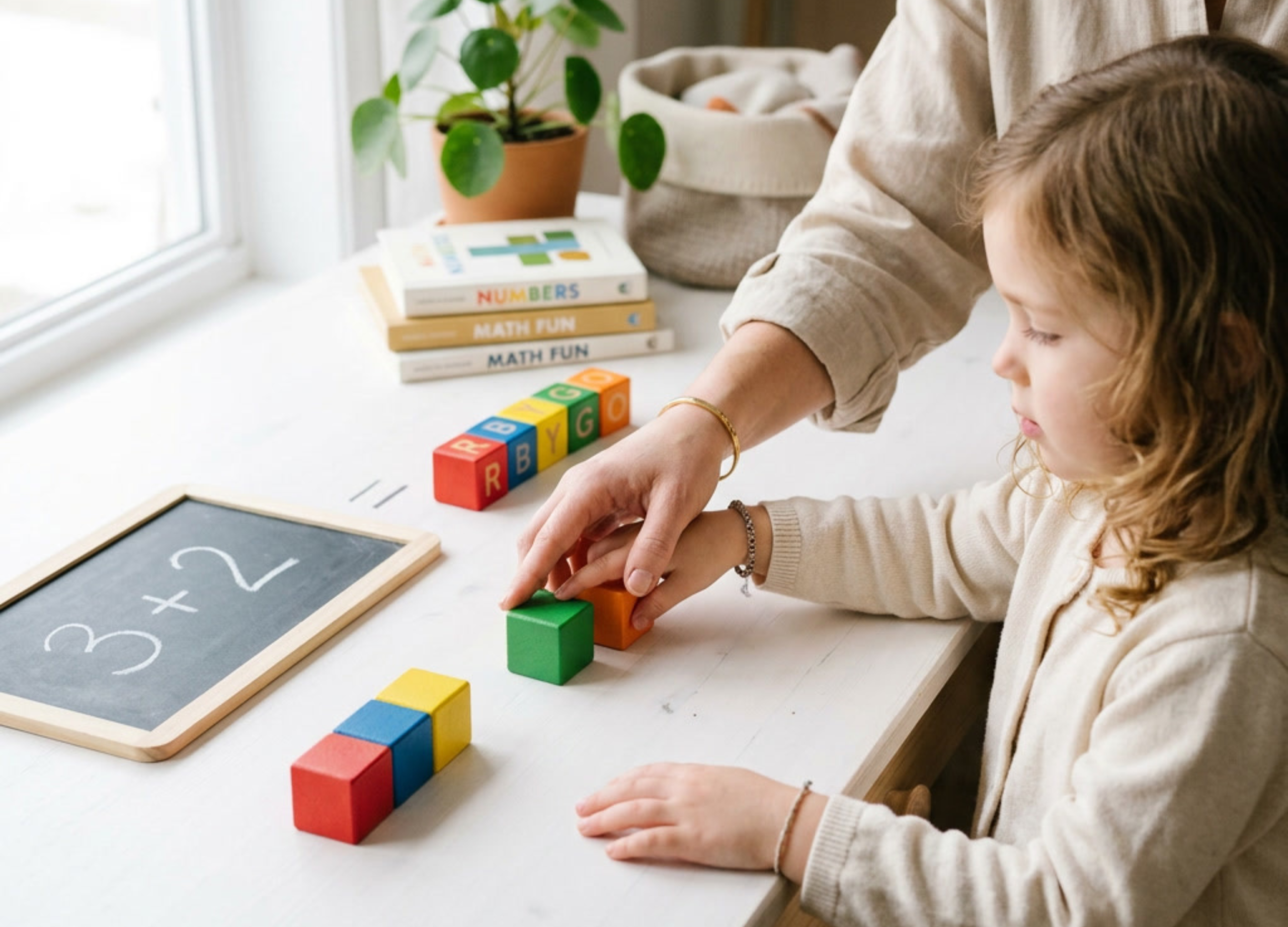
Let’s say today you’re practicing 3 plus 2. Don’t just write it on a piece of paper. Get some small objects. Coins. Blocks. Buttons. Crackers. Anything.
Put three on the table. Count them together. Then say, let’s add two more. Put two more next to them. Count all of them together. One, two, three, four, five.
Now do 4 plus 2. Start with four. Add two. Count.
Then 5 plus 2. Then 6 plus 2.
Let your child see the pattern growing. Let them touch the objects. Move them around. Count out loud.
This visual, physical connection helps math click in a way that a worksheet full of numbers just can’t. Some children need to see addition before they can do it in their heads. That’s not a weakness. That’s just how they learn.
The big mistake I keep seeing parents make
If I could tell you only one thing, it would be this.
Please, please do not rush.
I know the pressure is real. You worry they’re behind, about what the teacher thinks, about next year, and the year after that. You worry they’ll always struggle.
So you push harder. You add more problems. You move faster. You try harder strategies.
But here’s what I’ve learned the hard way. Pressure rarely creates understanding. It almost always creates anxiety. And an anxious brain does not learn well. It survives, shuts down, and finds ways to escape.
Children learn best when they feel safe enough to think. When they know that a wrong answer isn’t going to make you sigh or tense up. When they know you’re not in a hurry.
Sometimes slowing down is actually the fastest way forward. I know that sounds backwards, but I’ve seen it happen again and again.
When your child says “I’m bad at math”
This one hurts to hear. You can hear the belief forming in real time, and you know how hard it will be to undo later.
Your first instinct might be to say, no you’re not, that’s not true. But that usually doesn’t help, because your child’s experience tells them they are struggling, and they don’t believe you.
Instead, try something like this.
“You’re still learning this. That’s all. You’re just in the middle of learning it.”
Or: “This feels tricky right now, but every time you practice, your brain gets a little stronger. That’s how learning works.”
It’s a small shift in words, but it changes everything. Instead of telling your child who they are, you’re telling them what’s happening right now. And you’re teaching them that effort leads to improvement.
Over time, that belief matters more than any single math fact.
One last thing to you parent
If you’re reading this, you’re already doing more than you think. You’re showing up. You’re looking for answers. You’re trying to help. That matters. That matters so much more than you know.
Your child does not need a perfect teacher. They don’t need a math expert. They don’t need fancy programs or expensive workbooks.
They need a parent who stays patient. Who keeps showing up. Who believes, even on the hard days, that they can learn.
And they will. Not in a straight line. Not without setbacks. But slowly, piece by piece, one tiny moment at a time.
Addition will get easier. Confidence will grow. And one afternoon, maybe sooner than you think, your child will solve a problem they once thought was impossible, and they’ll look up at you like it was no big deal.
And you’ll know. It was working all along.
A simple path forward
The hardest part of all this is usually knowing what to practice next. What’s too hard? What’s too easy? When do you move on? When do you stay put?
That’s exactly why I’m working on a simple daily math plan for parents who don’t want to guess anymore. No guesswork. No overwhelm. Just a clear, gentle path that helps your child feel capable again.
Because when math feels manageable, children stop fearing it.
And they start believing they can do hard things.