The 10-minute daily math routine that actually works for kids
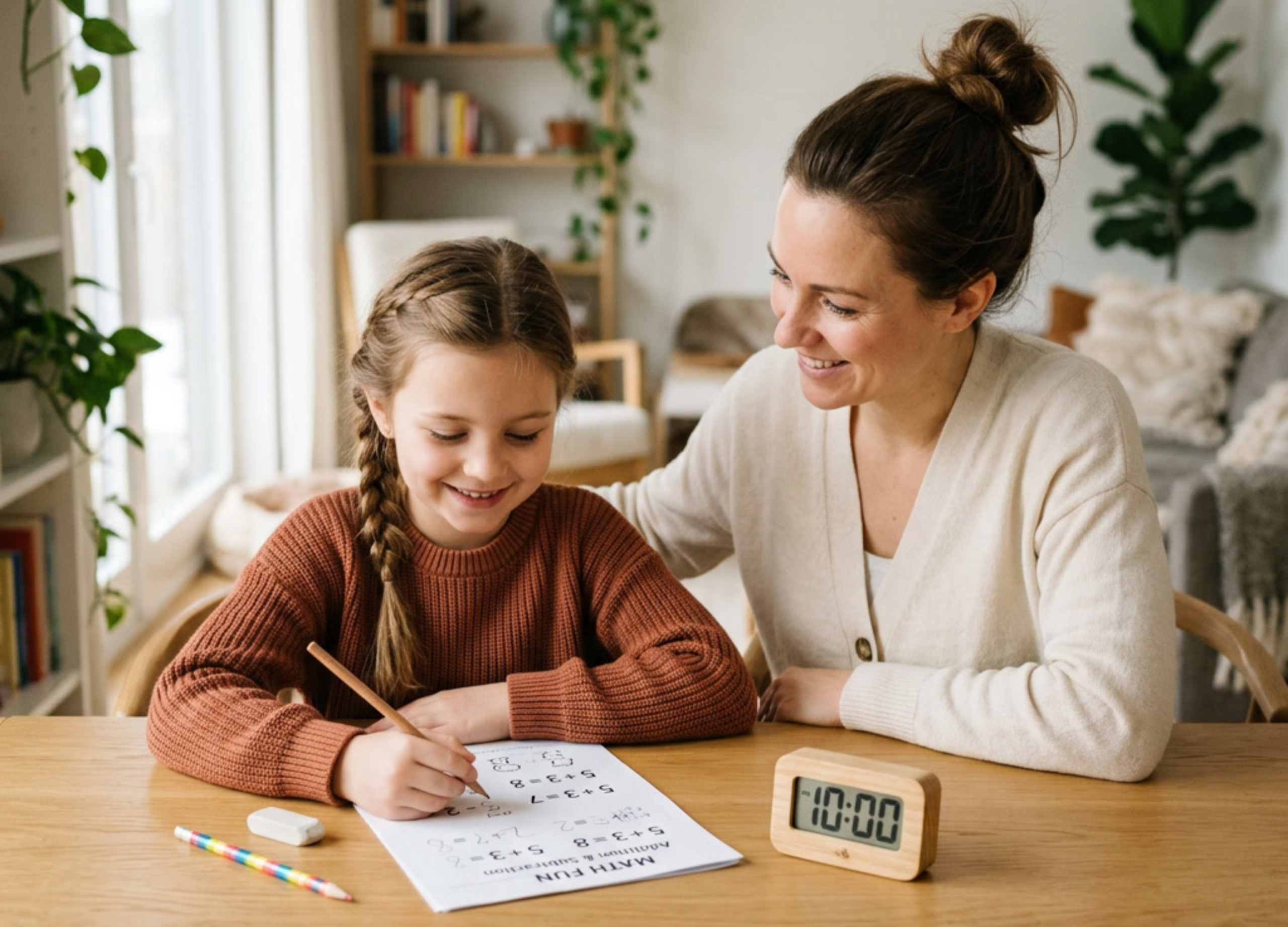
What if improving your child’s math skills didn’t take hours, but just 10 minutes a day?
If math has become a source of stress in your home, you are far from alone.
Maybe homework time feels like a daily battle. You sit down with the best intentions, hoping tonight will go differently, only to watch your child grow frustrated within minutes. The problems that seemed manageable yesterday suddenly feel impossible today. Focus disappears, patience runs thin, and before long, both of you are exhausted.
As a parent, those moments can feel discouraging.
You start wondering if you’re doing enough. You question whether your child is falling behind. Sometimes you even wonder if you’re somehow making it harder by not knowing exactly how to help.
And because we care so deeply about our children succeeding, our first instinct is usually to do more.
More worksheets.
Longer practice sessions.
More explanations.
More pressure to “just focus.”
It makes sense. We assume more time should mean better results.
But when it comes to helping children build real math confidence, more is not always better.
In fact, for many kids, the biggest breakthrough comes when parents do less—but do it consistently.
Sometimes all it takes is ten calm, intentional minutes a day.
Not an hour, a complicated lesson plan, or an expensive program.
Just 10 focused minutes that feel manageable for both of you.
It sounds almost too simple, but this kind of steady practice often works far better than long, draining study sessions that leave everyone frustrated.
And if math has felt overwhelming lately, that’s very good news.
Because it means progress does not have to come through pressure.
It can come through consistency.
Pin it for later!

Why this works so well for kids
As parents, we often underestimate how much emotional energy learning requires.
When children struggle with math, it usually isn’t because they are lazy or incapable. Most of the time, they are mentally overloaded.
Math asks children to hold multiple pieces of information in their minds at once. They have to remember steps, process numbers, solve problems, check their thinking, and often do all of it while worrying about getting the answer wrong.
That is a lot for a young brain to manage.
And when children feel overwhelmed, their brains naturally push back.
This is often when parents notice the behaviors that feel so confusing in the moment.
A child who understood the concept yesterday suddenly seems lost. They become distracted by everything around them. They stall, complain, get silly, or shut down completely.
It can look like resistance.
But often, it is simply overload.
Long study sessions tend to make this worse.
The longer a child sits in frustration, the harder it becomes for their brain to stay engaged and absorb new information. What started as a learning opportunity quickly turns into stress—and stress blocks learning.
That’s why shorter practice sessions are often so powerful.
When math time is brief and predictable, children stay mentally fresh enough to actually learn. They are far less likely to feel overwhelmed because they know the session will end soon.
And perhaps most importantly, short daily practice helps children experience repeated success.
That repetition matters more than most parents realize.
Math confidence is not built through one big breakthrough moment.
It grows quietly, through dozens of small moments when a child thinks:
I know how to do this.
Those moments stack over time, and eventually, something shifts.
The child who once resisted math begins approaching it with less fear, begins trying without being pushed, and starts believing they can improve.
And that belief changes everything.
POST: Why your child struggles with math and what you can do today
The power of consistency over intensity
Parents often feel pressure to “catch their child up” quickly.
If your child has been struggling, it can feel urgent to fix everything at once. That urgency often leads to long sessions filled with extra practice, corrections, and explanations.
But learning rarely works that way.
Children do not usually improve because they spent one exhausting evening working through ten pages of problems.
They improve because they practiced one skill repeatedly until it became familiar.
Think about how children learn to read.
We do not expect them to master reading after one long lesson.
We understand they need daily exposure to letters, sounds, and words. Progress happens gradually, through repetition, and math works exactly the same way.
A little practice every day gives the brain repeated opportunities to strengthen connections.
And those small repetitions are what eventually create fluency.
Ten minutes a day may not feel dramatic.
It may even feel too small to matter.
But done consistently, those minutes compound in ways that surprise parents all the time.
The 10-minute daily math routine for kids
The beauty of this routine is how simple it is.
You do not need to create elaborate activities, constantly search for new ideas, or any color-coded systems or hours of preparation.
You simply need a rhythm your child can trust.
Here is what that looks like:
Minutes 1–3: start with success
Begin with something your child already knows.
This could be reviewing multiplication facts, solving a few familiar addition problems, or practicing a concept they have recently mastered.
This opening matters because success changes a child’s mindset.
When children start math feeling capable, they are far more willing to keep going.
They begin the session thinking:
I can do this.
And that confidence carries into the next challenge.
Minutes 4–7: focus on one skill
This is your practice window.
Choose just one concept your child is currently learning.
It might be subtraction with regrouping, fractions, multiplication, place value, or word problems.
Keep it focused and manageable.
You do not need an entire workbook page.
A few well-chosen problems are enough.
The goal is not exhaustion, but understanding.
When practice feels small enough to succeed, children are much more likely to stay engaged and try their best.
Minutes 8–10: end with a win
This final step is often overlooked, but it is one of the most important parts of the routine.
Before math time ends, return to success.
Let your child solve one easy problem independently, explain what they learned, or repeat something they just practiced correctly.
Ending with success shapes how they remember the experience.
And children remember feelings more than worksheets.
When math ends with confidence instead of frustration, they are more willing to return tomorrow.
That consistency becomes easier.
And consistency is what creates growth.
Repetition builds confidence
Many parents worry that repeating the same kinds of problems will bore their child.
We often feel pressure to keep learning exciting by constantly introducing something new.
But children do not build confidence through endless novelty.
They build confidence through familiarity, and repetition allows the brain to recognize patterns.
It turns confusion into understanding and effort into fluency.
What feels repetitive to us often feels reassuring to a child.
It gives them the chance to think:
I’ve done this before. I know what to do.
And every time they experience that feeling, their confidence grows.
That confidence is what prepares them for harder challenges later.
You do not need twenty different activities
It is easy to feel like helping your child means doing more.
The internet is full of beautifully designed learning setups, printable bundles, games, manipulatives, and creative systems.
While those tools can absolutely be helpful, they are not what creates progress.
What matters most is whether your child practices consistently.
A simple routine you can realistically follow every day will always outperform an elaborate system you abandon after a week because it became too overwhelming to maintain.
Children thrive on predictable rhythms.
And parents do too.
The simpler the routine, the easier it becomes to stick with it.
And the more likely your child is to benefit from it.
A ready-to-use routine is coming soon
If you’d like a ready-to-use version of this daily routine, I’m creating a simple step-by-step math program you can follow at home with your child.
It’s designed to make daily math practice easy, consistent, and stress-free—so you can help your child build confidence without wondering what to do next.
Stay tuned. It’s coming soon.