8 Kitchen math activities for kids ages 6–7 that build real-life skills
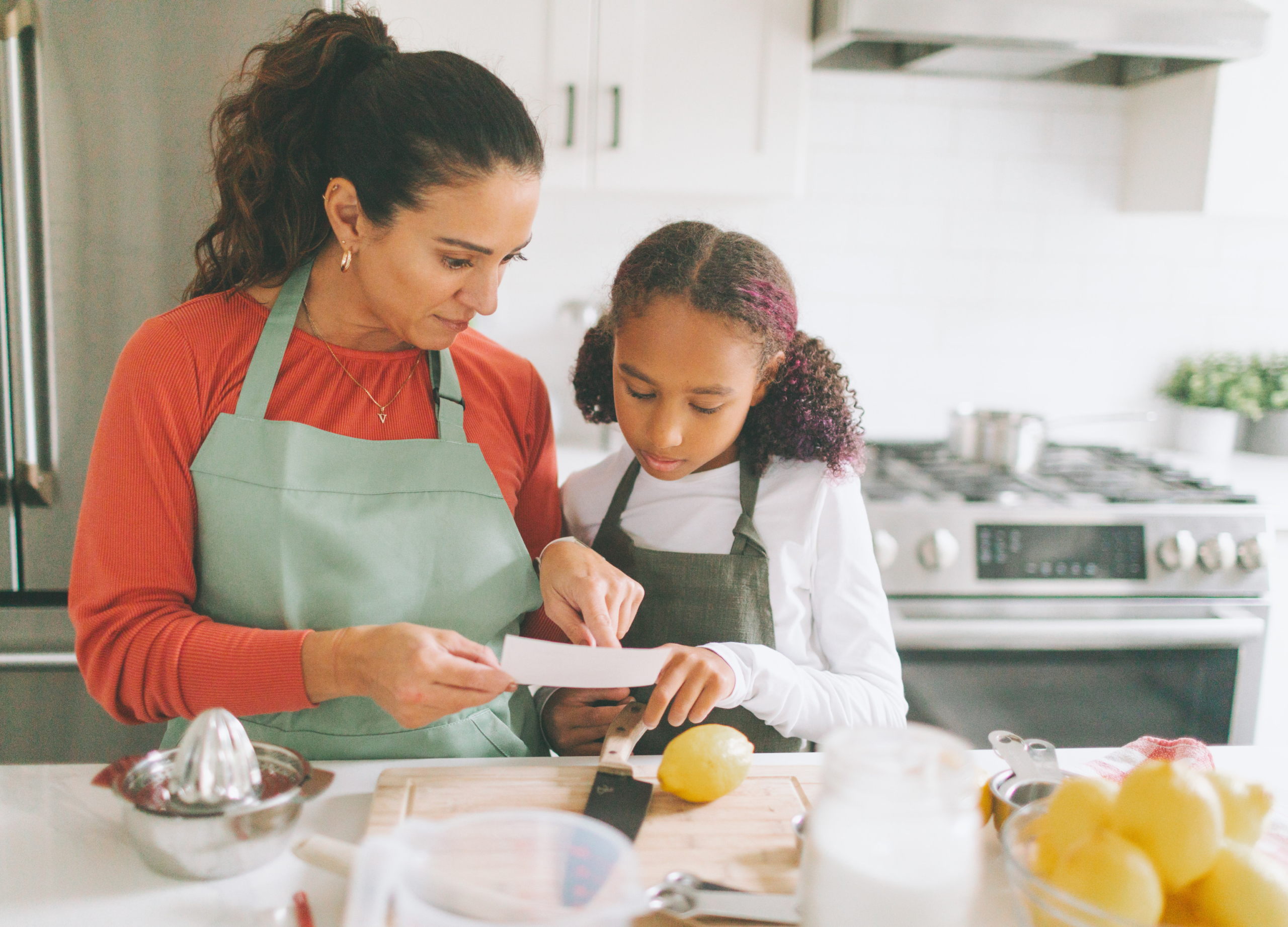
Mathematics becomes most meaningful for children when it is connected to everyday life.
At ages 6 and 7, children are developing foundational number sense, logical reasoning, and problem-solving skills that will shape their future success in mathematics. While structured lessons and worksheets can support learning, children often build deeper understanding when mathematical ideas are experienced in practical, familiar settings.
The kitchen provides one of the most effective environments for this kind of learning.
Recipes involve measurement and sequencing. Grocery planning introduces budgeting and number comparison. Cooking routines naturally create opportunities to explore time, quantity, estimation, and mathematical reasoning in ways that feel purposeful rather than academic.
When children engage with math in these contexts, they begin to recognize an important truth:
Mathematics is not simply a school subject. It is a practical life skill used every day.
The following kitchen-based activities are designed for children ages 6–7 and help strengthen essential mathematical concepts while building independence, confidence, and real-world problem-solving ability.
Pin it for later!
1. Measuring ingredients to develop fraction awareness
Measurement is one of the most practical ways to introduce mathematical thinking.
Invite your child to assist with recipes by measuring ingredients using cups and spoons. Ask them to locate specific measurements such as:
- 1 full cup
- ½ cup
- ¼ teaspoon
- 2 tablespoons
Encourage them to compare sizes and observe how smaller measurements combine to create larger ones.
For example, when two half-cups are poured into a bowl, children can physically see how they equal one whole cup. This hands-on experience helps establish an intuitive understanding of fractions long before formal fraction lessons begin in school.
Beyond numerical understanding, measuring also develops attention to detail and accuracy.
Mathematical skills developed:
- Fraction awareness
- Quantity comparison
- Precision
- Sequential thinking
Real-life skill developed:
Following instructions carefully and accurately.
2. Adjusting recipes to strengthen multiplication and division thinking
Recipe adjustments provide an excellent opportunity for mathematical reasoning.
Present simple questions such as:
- If the recipe uses 2 eggs, how many are needed to double it?
- If the recipe requires 1 cup of milk, how much is needed for half the recipe?
Allow your child time to reason through the problem independently before offering guidance.
These practical adjustments introduce multiplication and division concepts in a highly meaningful context. Instead of solving isolated textbook problems, children are applying mathematical reasoning to accomplish a real objective.
This approach supports flexible thinking and helps children understand why mathematical operations matter.
Mathematical skills developed:
- Multiplication foundations
- Division foundations
- Logical reasoning
- Numerical flexibility
Real-life skill developed:
Scaling quantities to meet practical needs.
3. Grocery budget planning to build financial awareness
Financial literacy begins with simple number experiences.
Create a pretend grocery budget and present several ingredient options with prices.
For example:
- Bread — €3
- Fruit — €4
- Yogurt — €2
- Cheese — €5
Ask your child to choose items while staying within a set budget.
Guide them through questions such as:
- How much will this cost altogether?
- How much money remains?
- Which combinations fit the budget?
This activity reinforces arithmetic skills while introducing children to thoughtful decision-making and financial planning.
It also encourages children to think critically about trade-offs and prioritization.
Mathematical skills developed:
- Addition
- Subtraction
- Money calculation
- Number comparison
Real-life skill developed:
Budgeting and financial decision-making.
4. Timer activities for understanding elapsed time
Time concepts often become clearer when connected to visible routines.
Use kitchen timers during cooking or baking and involve your child in monitoring progress.
Ask questions such as:
- The cookies bake for 15 minutes. If 6 minutes have passed, how many remain?
- Dinner must be ready by 6:30. If preparation takes 20 minutes, when should cooking begin?
This makes elapsed time more concrete and easier to visualize.
Children begin understanding how time moves, how intervals relate to one another, and how planning depends on accurate timing.
Mathematical skills developed:
- Elapsed time calculation
- Counting backward
- Subtraction
- Time sequencing
Real-life skill developed:
Time management and planning.
5. Sorting food items to build classification skills
Sorting is a foundational mathematical skill that supports later work in data organization and pattern recognition.
Provide small kitchen items such as:
- Pasta shapes
- Fruit pieces
- Crackers
- Beans
Ask your child to sort them according to different criteria:
- Size
- Shape
- Color
- Type
Then extend the activity by asking comparison questions:
- Which group has more?
- Which has fewer?
- Can the groups be made equal?
These observations strengthen analytical thinking and encourage systematic reasoning.
Mathematical skills developed:
- Classification
- Counting
- Comparison
- Pattern recognition
Real-life skill developed:
Organization and analysis.
6. Setting the table to introduce repeated addition
Setting the table provides natural exposure to multiplication concepts.
Ask your child to determine what is needed for each family member.
For example:
If 5 people each need:
- 1 plate
- 1 fork
- 1 spoon
- 1 cup
How many total items are required?
Children begin recognizing repeated groups, which lays the groundwork for multiplication.
Because the task is practical and purposeful, mathematical thinking feels relevant rather than abstract.
Mathematical skills developed:
- Repeated addition
- Grouping
- Early multiplication reasoning
Real-life skill developed:
Responsibility and preparation.
7. Estimation activities to improve number sense
Estimation develops intuitive understanding of quantity.
Fill a clear container with small kitchen items such as pasta or beans and ask your child to estimate how many are inside.
After recording their prediction, count together and compare the result.
Discuss whether the estimate was high or low and explore the reasoning behind it.
This process helps children become more comfortable making numerical judgments without relying solely on exact counting.
Mathematical skills developed:
- Estimation
- Numerical reasoning
- Quantity recognition
Real-life skill developed:
Making informed approximations.
8. Reading nutrition labels to practice data comparison
Nutrition labels offer valuable opportunities for mathematical interpretation.
Choose two food packages and compare numerical information such as:
- Sugar content
- Protein grams
- Serving sizes
Ask questions such as:
- Which product has more sugar?
- How much more does it contain?
- Which value is smaller?
This encourages children to interpret numerical data in a meaningful context and strengthens comparison skills.
Mathematical skills developed:
- Data interpretation
- Number comparison
- Subtraction reasoning
Real-life skill developed:
Critical decision-making using information.
Why everyday practice matters
Children build mathematical confidence through repeated, meaningful experiences.
When math is woven into daily life, it becomes familiar rather than intimidating.
This familiarity reduces anxiety and encourages children to approach mathematical challenges with greater confidence and curiosity.
The kitchen offers countless opportunities for this kind of learning.
A measuring cup, a recipe card, a timer, or a grocery list can become powerful teaching tools when used intentionally.
Over time, these small experiences help children develop something far more valuable than correct answers alone:
A lasting belief in their ability to solve problems independently.
And that confidence becomes the foundation for future mathematical success.
Download your 1st week plan
If you would like a simple structure to support this, I have created a free 1-week introduction to a 10-minute daily math routine designed specifically for children ages 6–7.
It is built for busy families and focuses on short, manageable daily practice that fits naturally into everyday life—without worksheets, pressure, or preparation-heavy lessons.
Each day includes a clear 10-minute activity that helps children build confidence step by step while keeping math light and approachable.
The goal is not more work for parents. The goal is consistency that actually fits into real family life.
👉 You can download the free 1-week 10-minute math routine here: [insert link]