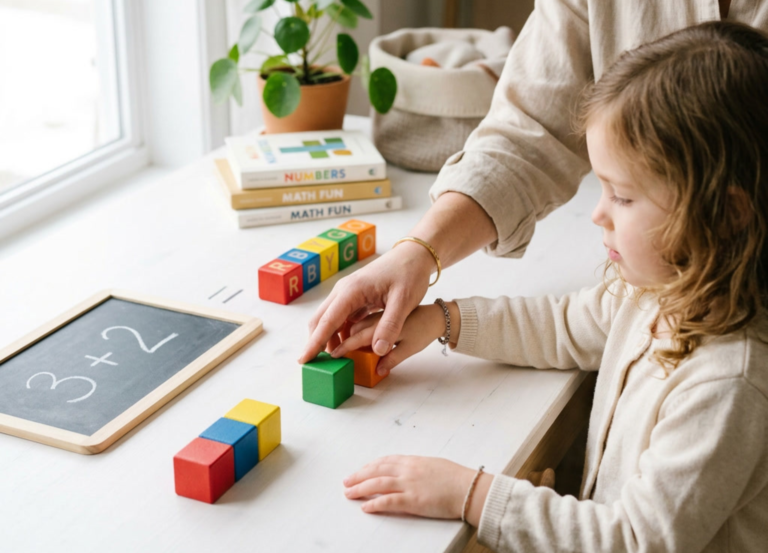
Why your child struggles with math and what you can do today

You sit down for homework time.
Your child stares at the page and sighs.
Maybe they get frustrated. Maybe you get frustrated, too.
And somewhere in the middle of multiplication problems and unfinished worksheets, you start wondering:
“Why is math so hard for my child?”
If this sounds familiar, you’re not alone.
So many parents worry that their child is “falling behind” or simply “not a math person.” But in most cases, that’s not true at all.
Children usually don’t struggle with math because they lack intelligence.
They struggle because math was taught in a way that didn’t truly connect with them.
And the good news? That can change.
If you want to find out why your child struggles with math, you are in the right place. Let’s break it down!
Pin it for later!
Why your child struggles with math + simple ways to help at home
1. They don’t fully understand the basics
Math works like building blocks.
If a child doesn’t fully understand one concept, the next lesson becomes much harder.
For example:
- A child struggling with multiplication may actually still feel unsure about addition.
- A child struggling with fractions may not fully understand division yet.
This is incredibly common.
But many children feel embarrassed to ask for help, so they stay quiet and try to “guess” their way through math.
Eventually, they lose confidence.
Signs to look for:
- Counting on fingers for simple sums
- Struggling with basic facts
- Getting stuck quickly
How you can help:
Slow down and revisit the basics without pressure – but make it fun.
Use:
- Coloring pages with numbers
- Simple math games
- Visual tools (like drawing or objects)
Even 10–15 minutes of playful practice each day can make a huge difference.
2. Math feels too abstract
For many kids, math feels like random numbers on a page.
They can’t see it—so they can’t understand it.
Example:
“5 + 3” means nothing… until they see 5 apples + 3 apples.
Some children learn best by:
- Seeing
- Touching
- Moving
- Drawing
- Or turning problems into stories
But traditional math teaching is often very worksheet-heavy and repetitive.
That works for some kids, but for others, it makes math feel cold, confusing, and disconnected.
How you can help:
Try making math more visual and interactive:
- Use drawings
- Counting objects
- Use printable worksheets with colors
- Turn problems into stories
- Use everyday situations (shopping, cooking)
A child who struggles with numbers on paper may suddenly understand math perfectly when using snacks, toys, or visuals.
So when math becomes something they can touch and see, it clicks much faster.
Sometimes the problem isn’t the child, but the method. And we know that children may learn differently than school teaches (I’ve been there).
3. They’re afraid of making mistakes
Some children shut down because they’re scared of being wrong.
This creates anxiety—and anxiety blocks learning.
Many kids become anxious around math earlier than parents realize.
You may notice:
- Tears during homework
- Shutting down quickly
- Saying “I’m stupid,”
- Or giving up before trying
Often, they’re not refusing because they’re lazy, but because they are afraid of failing.
How you can help:
Change the environment:
Your reaction matters more than perfection.
Instead of saying: “No, that’s wrong.”, try: “Good try — let’s figure it out together.”
Instead of focusing only on correct answers, celebrate:
- Effort,
- Patience,
- Improvement,
- And persistence.
Confidence grows when children feel emotionally safe while learning.
- Praise effort, not just correct answers
- Say things like “Let’s figure it out together.”
- Normalize mistakes as part of learning
Confidence grows when kids feel safe to try.
4. It feels boring
Let’s be honest—traditional math practice can feel repetitive.
Pages of repetitive exercises don’t inspire most children, and when kids are bored, distracted, or emotionally disconnected, learning becomes harder.
How you can help:
Make math enjoyable. You can try
- Themed worksheets
- Puzzles
- Math games
- Coloring activities
- Scavenger hunts
- Or reward systems
Learning does not always have to feel serious to be effective. Children learn best when they feel curious, relaxed, and engaged.
5. They memorized instead of understanding
Many children are taught to memorize steps without truly understanding why something works.
This becomes a problem later when math gets more advanced.
For example, a child may memorize multiplication tables but still not understand what multiplication actually means.
So when lessons become more complex, everything suddenly falls apart.
How can you help:
Focus on understanding before speed.
Ask questions like:
- “Can you explain how you got that answer?”
- “Can you show it another way?”
When children truly understand concepts, math becomes much less frightening.
6. They struggle to concentrate
Sometimes math difficulties are not really about math.
A child who is:
- Tired
- Overstimulated
- Distracted
- Anxious
- Or mentally exhausted
will naturally find it harder to focus and process information.
Math requires concentration, memory, and patience — which can feel impossible when a child’s brain is overwhelmed.
How can you help:
Create a calmer learning environment:
- shorter practice sessions
- fewer distractions
- movement breaks
- and realistic expectations
Even 10 focused minutes can work better than an hour of stress.
A simple shift that changes everything
When children struggle with math, parents often assume they need more pressure, more practice, or stricter routines.
But often, the answer is much simpler.
Most children struggle because:
- They missed an important step along the way
- It wasn’t explained in a way that works for them
- Learning has started to feel stressful instead of encouraging
- They need more repetition to feel secure
When you make small changes to how math is practiced at home, something powerful happens:
It begins to feel easier, your child feels safer making mistakes, and confidence starts growing naturally.
That’s often when math becomes less of a daily battle, and sometimes even something your child enjoys.
Want to make math easier and more fun?
If you’re looking for simple, playful ways to help your child practice math without stress…
👉Check out my printable math activities designed for kids ages 6–7
(Perfect for building confidence while having fun)
Final thoughts
As a parent, it can be painful to watch your child struggle with math.
You may feel unsure how to help, or you may worry they’re falling behind.
And sometimes, homework time can become stressful for everyone involved.
But one of the most important things to remember is this:
Your child does not need a perfect teacher at home, but a supportive parent who believes in them.
The way your child feels about math often matters just as much as the math itself.
When children constantly hear:
- “You need to try harder,”
- “This is easy,”
- or “Why don’t you understand?”
they can begin to believe they simply aren’t smart enough.
But when they hear:
- “It’s okay to make mistakes,”
- “We’ll figure this out together,”
- and “I’m proud of you for trying,”
their confidence slowly starts to grow again.
And confidence changes learning.
You don’t need long study sessions or complicated methods to help your child improve.
Often, the biggest difference comes from small daily moments:
- practicing together for a few minutes,
- making math feel playful,
- celebrating little wins,
- and creating a calm environment where your child feels safe to learn.
Progress in math rarely happens overnight. But with patience, encouragement, and the right support, children can rebuild both their skills and their confidence step by step.